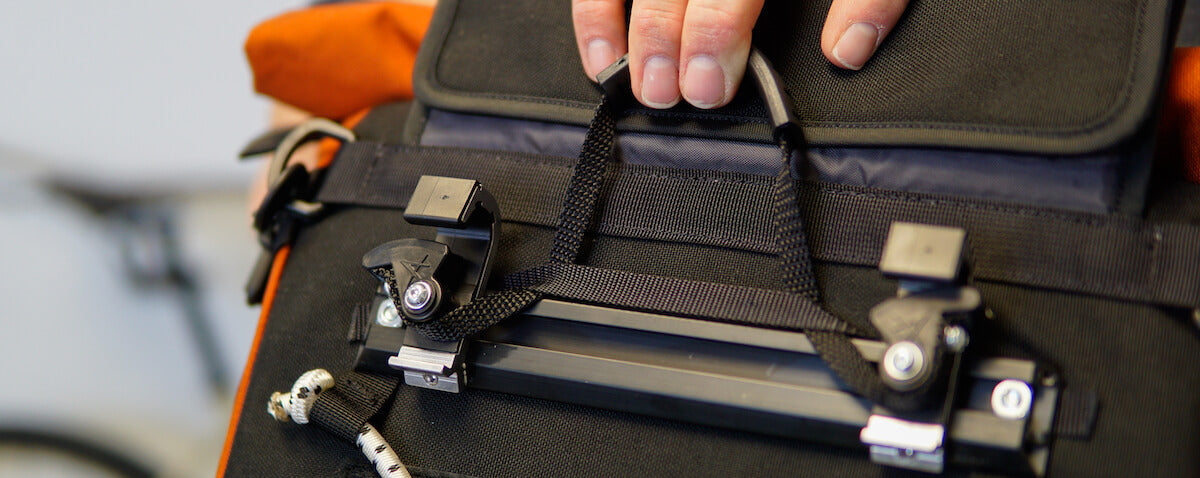
Cam-Lock® attachment system
|
How the system works
Anatomy of the Arkel Cam-Lock® attachment system
|
||
|
|
||
|
The Arkel Cam-Lock® hook system is a jewel of simplicity and reliability. Simple: You pull up the handle, it opens the cams, you release the handle and the cams firmly lock on the rack tubing. No need for special inserts; the Cam-Lock® will automatically fit rack tubing of 8mm to 15mm diameter. Reliable: The hooks and rail are made of virtually unbreakable aluminum. The inside of the hooks are lined with a nylon insert to protect your precious rack finish. Also, a thermoplastic insert is incorporated inside the cams at the tube contact area so that the cams firmly grip to the rack tubing and prevent any creep of the panniers along the rack. The position of the Cam-Lock® hooks is adjustable inside the rail to fit just about any rack on the market. The Arkel Cam-Lock® attachment system: solid, easy and efficient! You still have to pedal but you can do it in pure peace of mind! |
||
Step 1: Engage the bottom wire-hook of the pannier to any part of the rear rack near the wheel axle. |
||
Step 2: Lift the carry handle to open the cams and hook the pannier on your rack. When releasing the handle, the cams will lock onto your rack. |
||
Make sure that the hooks are well seated and that the cams firmly close underneath the tubing. |
||
|
|
||
|
It is possible to adjust the hooks to custom fit your rack. You may want to do so to give more heel clearance for the panniers when you pedal, or to match the spacing of the struts on your rack. It's simple to do and the customization is infinite! |
||
Step 1: Using a 3 mm Allen key, loosen the set screw at the base of the aluminum hook. |
||
Step 2: Slide the hook to the desired position (it can sometimes be done directly on the rack). |
||
Step 3: Re-tighten the set screw. Voilà !!
|
||
|
Slotted hook retention system: Why? |
||
This is the most common set-up. The widely spaced hooks offer lots of stability and are easy to hook on the rack. |
||
Sometimes we may need all the heel clearance we can get (bike with short chainstays, rack with a short platform, crankset with long arms or simply big shoes!). When necessary it's possible to slide the panniers w-a-y back. Do not overdo it unless necessary as too much weight far back is hard on the rear wheel and can be felt in the bike handling. |
|
|
||
Channelled 3D extrusion: Why? |
||
30 degrees end cut: Why? |
||
Big screw and washer: Why? |
||
Square nut in channel: Why? |
||
"OverDesigned" Hooks: Why? |
||
The essence of the Arkel Cam-Lock® attachment system lies in the twin mirror cams that firmly grip on the rack tubing when the handle is released. Because of the opposing force of the cams that rotate in opposite directions, the pannier is locked in place and cannot move forward nor backward. Moreover, the geometry of the rotating cams relative to the aluminum hook portion is such that the same incredible retaining strength is achieved within the full range of rack tubing, thereby eliminating the need for any spacers or shims. And to ensure the absolute firmest grip of the cam to the rack tubing, a softer TPU (thermoplastic polyurethane) is incorporated into the cams at the rack tubing contact point. Finally, the cam surface has a concave shape that further confines the rack tubing so that no movement is possible. As for the cams themselves, they are made of a special blend of nylon, the type that snowboard bindings are made of. So you can ride in the cold of Siberian winters just as well as in the heat of Death Valley. As for the sealed spring that actuates the cams, stainless steel, of course. |
||
A bungee: Why? |
||
Nylon casing cut on a hot blade: Why? |
||
Nylon webbing pierced with a hot tip: Why? |
||
A simple knot: Why? |